Teaching Portfolio

Ernie Lindain

Nurse Educator|Critical Care Nursing|Nursing Professional Development Practitioner

Developing knowledgeable, confident, and clinically competent nurses through evidence-based, learner-centered education.

Portrait of Ernie Lindain

Welcome to My Teaching Portfolio

This portfolio represents my development as a registered nurse, nurse educator, and MSN Nursing Education student. My nursing background has given me extensive clinical experience, while my graduate program has expanded my knowledge of teaching and learning, curriculum development, assessment and evaluation, and evidence-based nursing education.

Here you'll find my educational projects, teaching experiences, teaching artifacts, and professional development activities — work that connects nursing knowledge and clinical practice with meaningful educational experiences that support learner development and safe patient care.

Portfolio Goals

As a developing nurse educator, my goal is to facilitate learning, design meaningful educational experiences, develop measurable objectives, assess learner achievement, and apply evidence-based teaching strategies. This portfolio also demonstrates my development in the NLN Nurse Educator Core Competencies and my commitment to continued reflection and professional growth.

About Me

Professional Profile

I am a registered nurse with extensive clinical experience and a developing specialization in nursing education. My career has included critical care nursing and caring for patients with complex, high-acuity conditions, working collaboratively with multidisciplinary healthcare teams.

My transition into nursing education has allowed me to combine clinical knowledge with educational theory and evidence-based teaching strategies. I am particularly interested in orientation, staff development, competency assessment, clinical education, and supporting nurses as they transition into new roles.

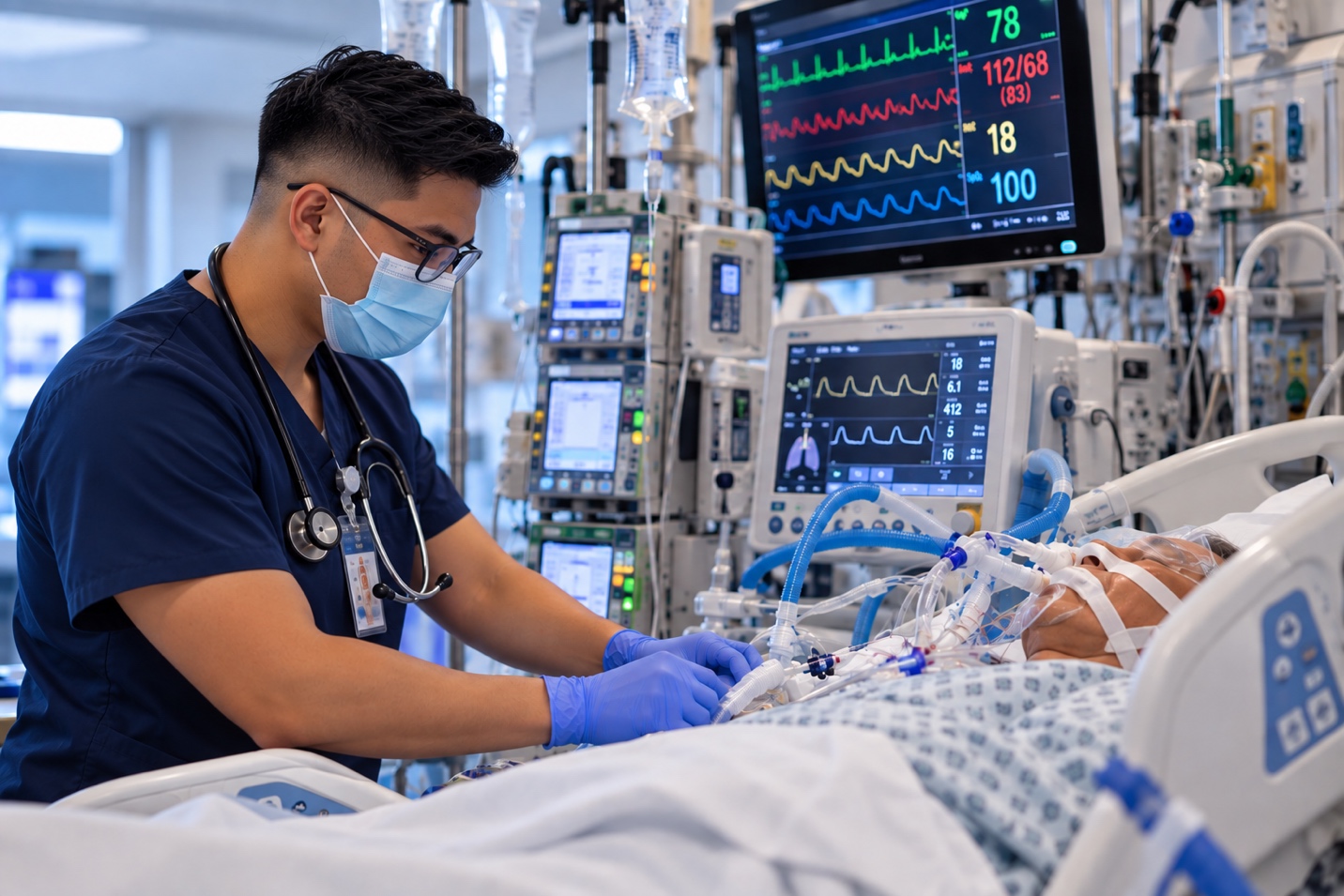
Ernie caring for a patient in a critical care unit

Education

  • Master of Science in Nursing – Nursing EducationWilliam Paterson University
  • Bachelor of Science in NursingRutgers University

Certifications

  • Certified Critical Care Nurse (CCRN)American Association of Critical-Care Nurses (AACN)
  • Certified Medical-Surgical Nurse (MEDSURG-BC)American Nurses Credentialing Center (ANCC)
  • ACLS & BLSAmerican Heart Association (AHA)

ACLS and BLS reflect my commitment to current competency in emergency cardiovascular care and patient safety, allowing me to model current standards and teach essential emergency response skills (NLN CNE Domains V & VI).

Professional Experience

My experience includes critical care nursing, nurse education, staff development, new-hire orientation, nurse residency education, clinical competency development, and patient and family education — experiences that have shown me the importance of connecting education to real-world nursing practice.

View Resume →

Teaching Philosophy

My teaching philosophy is influenced by Patricia Benner's Novice-to-Expert model, which recognizes that nurses develop knowledge, confidence, and clinical competence through education and experience (Benner, 1984). Learners enter educational environments with different levels of knowledge, experience, confidence, and clinical ability. My role is to recognize individual learner needs and create supportive experiences that promote growth, clinical reasoning, confidence, and independence.

Every learner brings prior knowledge, experience, and their own learning style — a visual learner may learn best from literature and charts, while a kinesthetic learner retains information through movement and hands-on practice. Rather than relying solely on lecture, I build on those experiences through repetition, demonstration, hands-on practice, discussion, simulation, and case-based learning that connect theory to real clinical situations.

I strive to create a supportive environment where nurses feel comfortable asking questions, practicing skills, receiving feedback, and reflecting on their practice. Bastable (2023) emphasizes selecting teaching strategies based on learner characteristics, and Billings and Halstead (2024) emphasize learner-centered approaches in nursing education.

The educator role serves as a facilitator, mentor, role model, evaluator, advocate, and lifelong learner.

Educational Projects

Projects that reflect my philosophy in practice — meeting learners where they are and guiding their development.

AM-PAC Mobility Goal Presentation

Staff Education / Clinical Documentation Learners: Registered Nurses

A practical guide for accurately documenting AM-PAC mobility assessments in Epic. The session helped nurses understand the AM-PAC scoring system, document it in the EHR, and connect accurate documentation to patient mobility and clinical care. It combined a PowerPoint presentation, step-by-step visual instructions, an Epic workflow demonstration, scoring review, and Q&A.

NLN Competencies13

Reflection: This project showed me the value of education nurses can apply immediately at the bedside, and reinforced the importance of presenting content in a clear, practical way.

View AM-PAC Presentation →

APRN Presentation: New York vs. New Jersey

Advanced Practice Registered Nurse Education Learners: Nursing Students / RNs

An educational comparison of APRN practice requirements in New York and New Jersey, helping learners understand regulatory differences and how state-specific laws influence advanced nursing practice. Delivered through a PowerPoint presentation, comparative discussion, state-specific examples, and Q&A.

NLN Competencies124

Reflection: Nursing practice is shaped by state laws, regulations, and scope of practice. This project strengthened my ability to organize complex information into a format learners can understand and apply.

View APRN Presentation →

Blood Transfusion Simulation

Simulation-Based Education Learners: Nursing Students / RNs

A simulation giving learners a safe, controlled environment to practice safe blood transfusion: patient assessment and identification, blood-product verification, monitoring, communication, and recognizing transfusion-related complications. It incorporated a clinical scenario, hands-on practice, clinical decision-making, feedback, and debriefing.

NLN Competencies123

Reflection: Direct observation during simulation helps identify strengths, knowledge gaps, and areas needing more practice, and debriefing lets learners see how their decisions affected the patient outcome (DeGagne & Oermann, 2025). I will continue using simulation to promote clinical judgment, confidence, and safe practice.

View Blood Transfusion Simulation →

Teaching Artifacts

Selected coursework from my MSN Nursing Education program.

NUR 5001 – Theoretical Foundations of Nursing

Enhancing Holistic Nursing Care

Explores nursing theory and holistic approaches to patient-centered care, and how nursing concepts influence patient care.

View Artifact →

NUR 6061 – Classroom Teaching Strategies

NCLEX-Style Post Quiz

Demonstrates learner assessment and evaluation — writing questions to determine whether learners achieved intended outcomes.

View Artifact →

NUR 5081 – The Role of the Advanced Practice Nurse

EBP APN Paper

A scholarly paper showing my development in evidence-based practice and how evidence informs nursing practice and decision-making.

View Artifact →

NUR 6050 – Curriculum Development

Interviewing Nursing Faculty

An interview with an experienced nursing faculty member exploring the responsibilities of nursing education and curriculum development.

View Artifact →

NUR 6001 – Advanced Health Assessment

SOAP Note Sample

Demonstrates clinical assessment, clinical reasoning, and organizing and communicating patient information in professional documentation.

View Artifact →

Teaching Experience

My teaching experiences include both direct and indirect educational activities.

Direct Teaching

  • Medication-adherence education for patients and families
  • Coping strategies for managing anxiety with psychiatric inpatients
  • Discharge education for patients and their families
  • Session for six newly hired nurses on rapid recognition of a deteriorating patient
  • Therapeutic communication and support resources for behavioral-health patients

Indirect Teaching

  • Assisted with orientation of newly hired nurses
  • Reviewed hospital policies and competency requirements with orientees
  • Assisted with skills validation during orientation skills day
  • Participated in nurse residency education for seven new graduate nurses
  • Reviewed and revised behavioral-health educational materials
  • Assisted with development of staff education programs
  • Participated in continuing education and mandatory competency activities

Oermann et al. (2023) emphasize clinical teaching strategies that connect theoretical knowledge with clinical practice and facilitate clinical reasoning.

Professional Development

Current Development

Continued education through the MSN Nursing Education program at William Paterson University, registered nursing practice, critical care experience, nurse educator experience, professional certification, and continuing education.

My graduate education has expanded my knowledge of learning theories, instructional strategies, curriculum development, assessment, evaluation, and evidence-based teaching.

Professional Goals

I plan to continue developing as an educator and Nursing Professional Development Practitioner, expanding my skills in curriculum development and program evaluation.

Ultimately, I want to help develop competent, confident nurses who provide safe, evidence-based, and patient-centered care.

Reflection

My Development as a Nurse Educator

My experiences as a nurse and graduate student have taught me that effective teaching requires more than delivering clinical information. It requires understanding the learner, their educational needs, appropriate instructional strategies, and whether learning was truly effective.

My MSN program has expanded my foundation in nursing education through learning theories, instructional strategies, curriculum development, assessment, evaluation, and evidence-based teaching. My projects and teaching experiences have built my confidence in creating learner-centered education and connecting measurable objectives with appropriate teaching and assessment strategies.

My strengths include clinical knowledge, communication, hands-on teaching, and group discussion. Going forward, I aim to keep growing as a teacher, pursue professional certification, contribute to nursing education scholarship, and develop programs that promote safe and competent nursing practice.

References
  • American Psychological Association. (2020). Publication manual of the American Psychological Association (7th ed.).
  • Bastable, S. B. (2023). Nurse as educator: Principles of teaching and learning for nursing practice (6th ed.). Jones & Bartlett Learning.
  • Benner, P. (1984). From novice to expert: Excellence and power in clinical nursing practice. Addison-Wesley.
  • Billings, D. M., & Halstead, J. A. (2024). Teaching in nursing: A guide for faculty (7th ed.). Elsevier.
  • DeGagne, J. C., & Oermann, M. H. (2025). Teaching in nursing and the role of educator (4th ed.). Springer Publishing.
  • Halstead, J. A. (2019). NLN core competencies for nurse educators: A decade of influence. National League for Nursing.
  • Oermann, M. H., Gaberson, K. B., & DeGagne, J. (2024). Evaluation and testing in nursing education (7th ed.). Springer Publishing.
  • Oermann, M. H., Shellenbarger, T., & Gaberson, K. B. (2023). Clinical teaching strategies in nursing (6th ed.). Springer Publishing.
  • Wittmann-Price, R. A., Godshall, M., & Wilson, L. (2021). Certified nurse educator CNE: Review manual (4th ed.). Springer Publishing.